


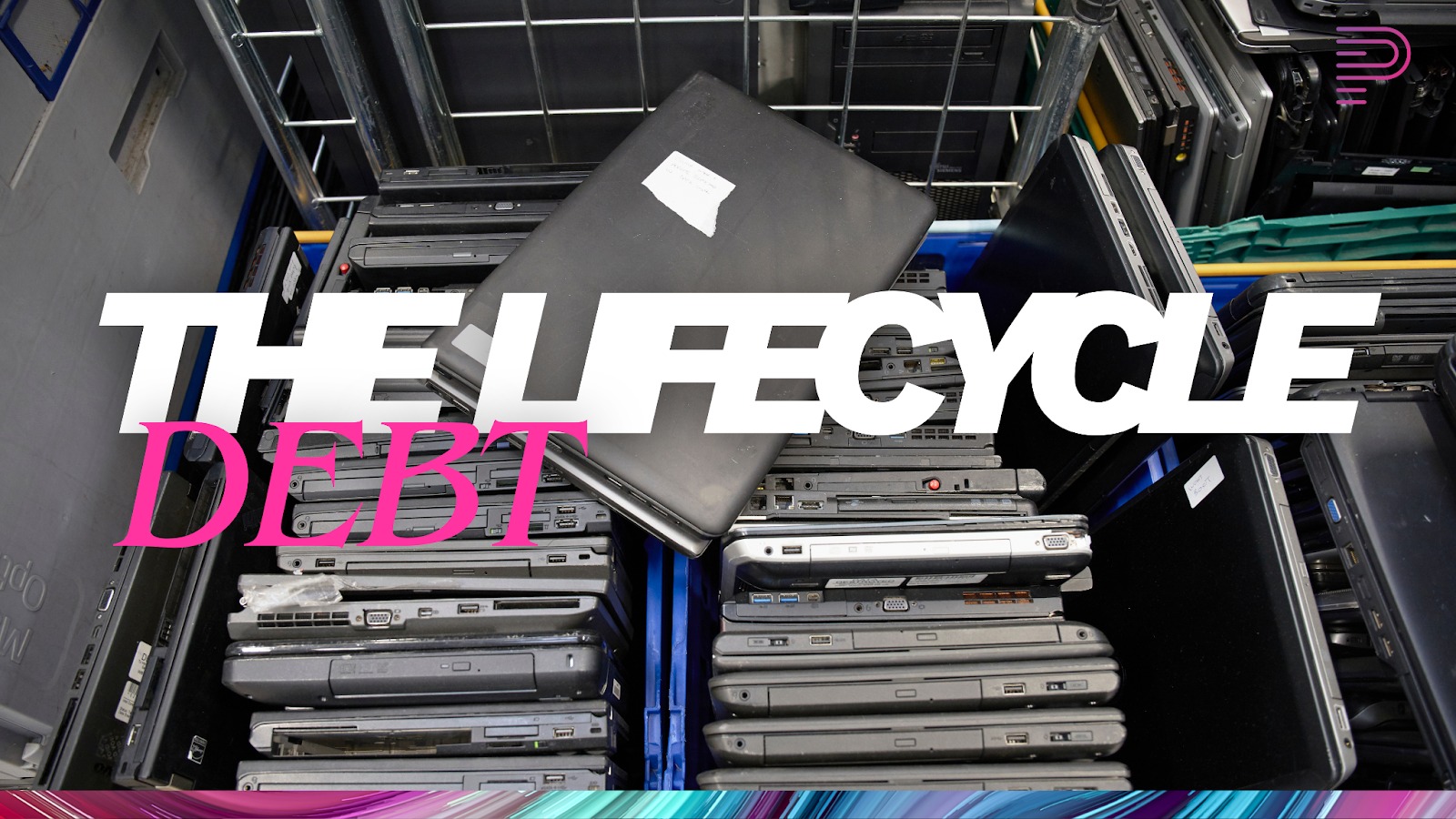
The Lifecycle Debt: When Product-as-a-Service Models Start to Age
Ownership used to define value. You bought a device, used it, replaced it. It was wasteful, but at least predictable. Then came the promise of access over ownership: Product-as-a-Service, Device-as-a-Service, Infrastructure-as-a-Service. Companies would keep responsibility for what they made, ensuring longer product lifecycles and sustainable asset recovery. It sounded circular. But as these models mature, a quieter truth is surfacing: the circular promise is aging faster than the products themselves.
The problem isn’t ideology, it’s arithmetic. Subscription, i.e. Product-as-a-Service, models depend on movement. Revenue comes from renewals, refreshes, and upgrades, not stillness. A laptop replaced every two years under a service contract generates predictable profit, but it also accelerates material exhaustion. Circular on paper, linear in practice. The same hardware could easily run for another three, maybe five years, yet the business model rewards replacement long before performance decline.
This is what might be called lifecycle debt, the environmental deficit that builds when we treat circularity as logistics instead of longevity. Financial depreciation is accounted for. Material depreciation is not. A service provider may recover every asset and even refurbish it, but when turnover cycles are compressed, the embodied carbon and extraction footprint of manufacturing new units cancel out the gains. Fast circularity is still a waste, just better dressed.
You see it clearly in data centers. Hardware-as-a-Service contracts promise maximum efficiency through constant refresh cycles, faster, smaller, lower-power servers delivered before the old ones slow down. The spreadsheets show optimization, but the atmosphere records the energy and carbon cost of every upgrade. The system becomes circular in paperwork and linear in physics. The loop spins faster, but not smarter.
None of this means the model should be abandoned. It means it has to evolve. The next phase of the Product-as-a-Service model, and product lifecycle management as a whole, should reward duration, not velocity. Imagine contracts that treat environmental depreciation like financial depreciation, tracking the true cost of replacing something that still works. Imagine a provider who profits not when a device is swapped, but when it stays in service another year. Circularity was never meant to be measured in rotations; it was meant to be measured in time.
Some companies are already shifting, building refurbishment clauses into agreements, basing fees on performance hours instead of fixed terms, or tying profitability to uptime rather than refresh frequency. These small changes matter because they realign the clock. When longevity becomes the metric, sustainability stops being a marketing claim and starts becoming a design principle.
The challenge is patience. Circular systems and models can’t compete on quarterly turnover; they compete on compound efficiency. Every extra year a product or asset remains productive multiplies savings in energy, labor, and materials. Over a decade, those small deferrals become the real advantage. The future of Product-as-a-Service models will belong to the companies that learn to slow the spin and who understand a sustainable loop is not the one that moves fastest, but the one that knows when to stop.
For more reading on innovations in the advancement of circular systems and business models, we recommend the work of the Ellen MacArthur Foundation.